Artificial Intelligence is no longer an emerging technology—it has become a core part of modern software engineering.In 2026, AI software development is helping businesses build smarter, faster, and more scalable applications while reducing development costs and improving efficiency. Businesses working with a custom software development company are increasingly integrating AI capabilities into their digital products to improve automation, scalability, and user experiences. From code generation and software testing to deployment automation and predictive analytics, artificial intelligence in software development is changing every stage of the software development lifecycle.
As businesses continue to accelerate their digital transformation initiatives, the demand for AI software development services is growing rapidly. According to PwC, artificial intelligence could contribute up to $15.7 trillion to the global economy by 2030, making AI one of the most impactful technologies for modern businesses. Organizations are looking for innovative ways to launch products faster, improve customer experiences, automate operations, and gain a competitive advantage. Whether you are a startup building an MVP or an enterprise modernizing legacy systems, AI software development offers significant opportunities to improve software quality and business outcomes.
What is AI Software Development?
AI software development refers to the use of artificial intelligence technologies such as machine learning, natural language processing, computer vision, predictive analytics, and generative AI to improve software creation, deployment, and maintenance. Unlike traditional software development processes that rely heavily on manual effort, AI helps automate repetitive tasks, identify patterns, generate code, predict issues, and optimize workflows.
Today, businesses are increasingly investing in AI software development services to build intelligent applications that can learn from data, adapt to user behavior, and deliver personalized experiences. According to IBM, AI is now being used across planning, coding, testing, deployment, monitoring, and maintenance processes
Core Technologies Used in AI Software Development
- Machine Learning (ML)
- Natural Language Processing (NLP)
- Deep Learning
- Generative AI
- Computer Vision
- Predictive Analytics
- Intelligent Automation
These technologies are driving a new era of AI application development across industries including healthcare, finance, retail, manufacturing, education, logistics, and SaaS.
Why AI is Transforming Custom Software Development
Traditional software development often involves lengthy planning, coding, testing, and maintenance cycles. AI software development is helping businesses overcome these challenges by improving productivity and reducing manual workloads.
Key Reasons Businesses Are Adopting AI
- Faster software delivery
- Reduced development costs
- Improved code quality
- Better software security
- Enhanced user experiences
- Automated testing and deployment
- Smarter business decision-making
- Increased scalability
As organizations seek faster time-to-market and higher software quality, AI-powered software development has become a strategic investment rather than an optional enhancement.
How AI is Transforming the Software Development Lifecycle
Artificial intelligence is now influencing every stage of custom software development.
1. Smarter Project Planning
AI tools can analyze historical project data to:
- Estimate project timelines
- Predict resource requirements
- Identify potential risks
- Improve project planning accuracy
This allows development teams to make better decisions before coding even begins.
2. AI-Powered Code Generation
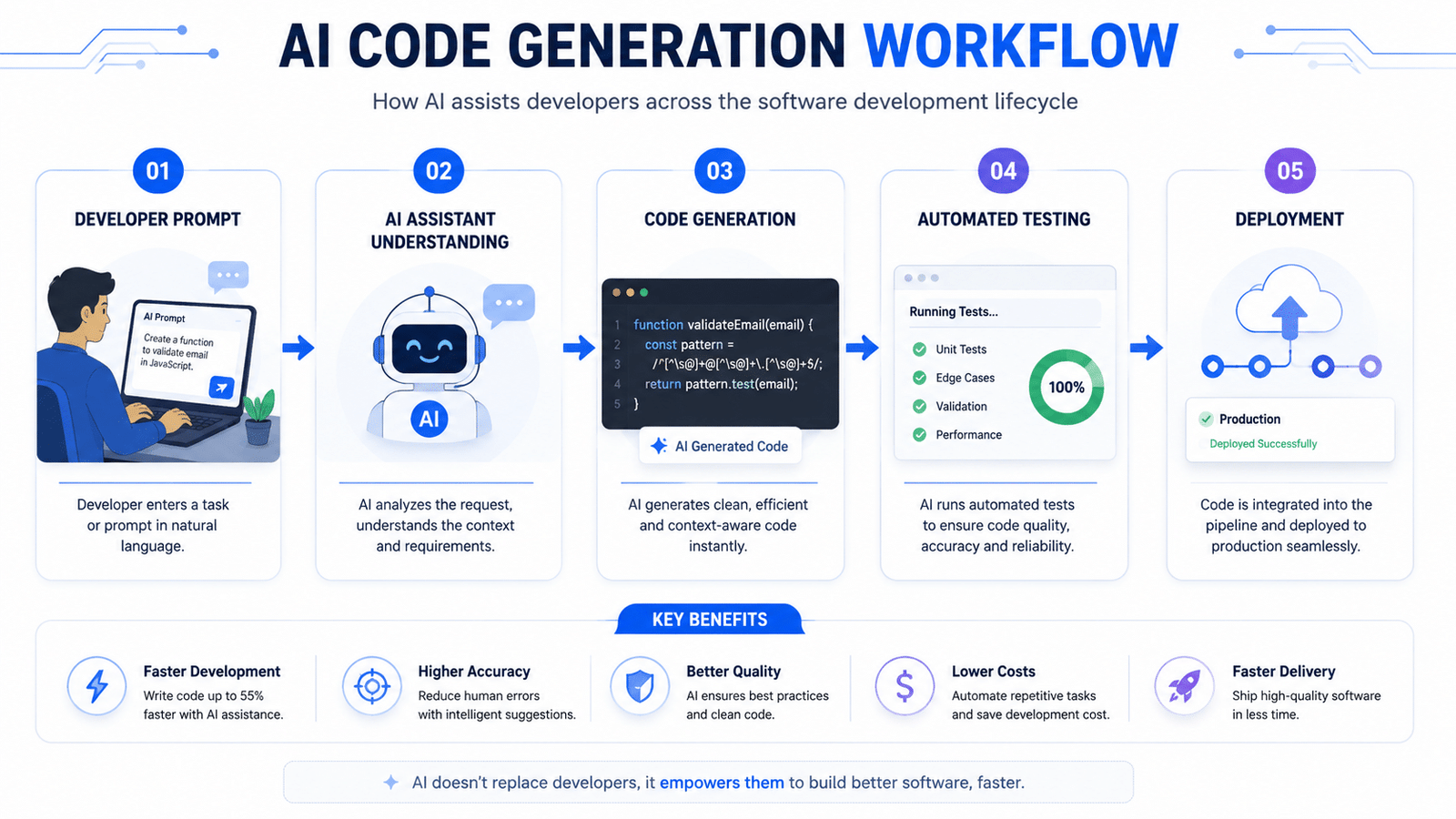
One of the biggest breakthroughs in AI software development is code generation. Modern AI tools can assist developers by:
- Generating code snippets
- Creating boilerplate code
- Recommending best practices
- Suggesting code improvements
- Reducing repetitive tasks
Generative AI in software development is significantly increasing developer productivity while allowing teams to focus on solving business challenges rather than repetitive coding activities. GitHub research found that developers using AI coding assistants completed coding tasks up to 55% faster than those without AI assistance. Organizations implementing machine learning solutions are increasingly adopting these technologies to accelerate development cycles. .
3. Automated Code Reviews
Code reviews are essential for maintaining software quality. AI-powered systems can:
- Detect coding errors
- Identify security vulnerabilities
- Enforce coding standards
- Recommend performance improvements
This results in cleaner and more secure applications.
4. Intelligent Software Testing
Software testing is one of the most time-consuming aspects of development. Businesses investing in software testing and quality assurance services can significantly improve product quality through AI-powered automation and predictive bug detection.
- Test case generation
- Regression testing
- Bug detection
- Performance testing
- User behavior simulation
Benefits include:
- Faster release cycles
- Improved software reliability
- Lower testing costs
- Better user experiences
5. AI-Driven DevOps Automation
AI-powered software development is transforming DevOps through advanced cloud and DevOps services that automate deployments, optimize infrastructure performance, and improve system reliability.
- Automated deployments
- Infrastructure monitoring
- Performance optimization
- Failure prediction
- Incident management
Organizations can deploy applications faster while reducing downtime and operational risks.
6. Predictive Maintenance
AI helps monitor software performance and identify issues before they affect users.
Businesses can:
- Detect anomalies early
- Predict system failures
- Automate maintenance tasks
- Improve software reliability
This proactive approach significantly reduces maintenance costs.
Key Benefits of AI Software Development
Businesses adopting AI software development are experiencing measurable improvements across development, operations, and customer engagement.
| Benefit | Impact |
| Faster Development | Reduced project timelines |
| Better Code Quality | Fewer bugs and errors |
| Cost Reduction | Less manual work |
| Improved Security | Faster threat detection |
| Enhanced UX | Personalized experiences |
| Better Scalability | Easier growth |
| Data-Driven Decisions | Smarter business strategies |
According to McKinsey, generative AI can improve software engineering productivity by 20% to 45% across development workflows, helping organizations reduce project timelines and improve software delivery efficiency
Faster Time-to-Market
AI automates many repetitive development tasks, helping businesses launch products faster and respond quickly to market demands.
Reduced Development Costs
By improving productivity and reducing manual effort, AI-powered software development lowers overall project costs.
Higher Software Quality
AI-driven testing and code analysis help identify issues early, reducing costly fixes after deployment.
Improved Security
AI tools continuously scan applications to detect vulnerabilities and unusual activity, helping businesses strengthen cybersecurity.
Personalized User Experiences
Modern applications can use AI to understand customer preferences and deliver highly personalized experiences. Combining AI with professional UI UX design services enables businesses to create more engaging and user-centric digital products.
Top Use Cases of AI in Custom Software Development
AI application development is creating new opportunities across industries.
AI Chatbots and Virtual Assistants
Businesses use AI-powered chatbots integrated into modern web development services to:
- Provide 24/7 support
- Answer customer questions
- Improve customer satisfaction
- Reduce support costs
Predictive Analytics Platforms
Organizations use AI software development to:
- Forecast demand
- Predict customer behavior
- Improve decision-making
- Identify growth opportunities
AI-Powered CRM Systems
AI enhances customer relationship management by:
- Scoring leads
- Automating follow-ups
- Predicting customer needs
- Improving sales performance
Many organizations combine AI-powered CRM systems with mobile app development services to create seamless omnichannel customer experiences.
Healthcare Applications
Artificial intelligence in software development is revolutionizing healthcare through:
- Medical diagnosis support
- Patient monitoring
- Personalized treatment plans
- Medical image analysis
Fraud Detection Systems
Financial institutions rely on AI-powered software development to:
- Detect suspicious transactions
- Prevent fraud
- Improve compliance
- Reduce financial losses
E-Commerce Personalization
Retail businesses use AI software development to provide:
- Product recommendations
- Personalized promotions
- Dynamic pricing
- Improved shopping experiences
Manufacturing Automation
AI helps manufacturers optimize:
- Supply chains
- Production planning
- Equipment maintenance
- Quality control
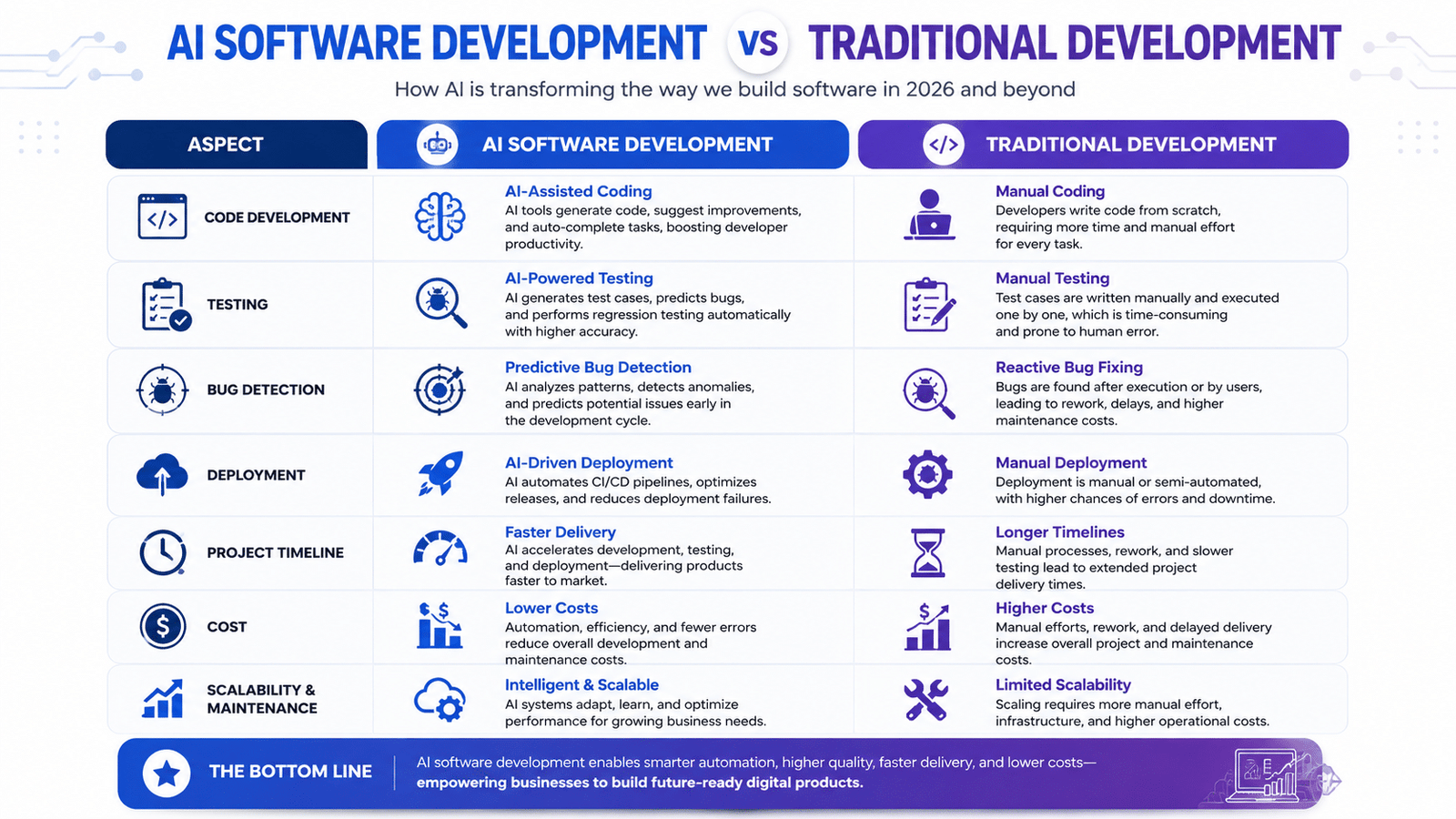
AI vs Traditional Software Development
| Feature | Traditional Development | AI Software Development |
| Coding Speed | Manual | AI-assisted |
| Testing | Mostly manual | Automated |
| Bug Detection | Reactive | Predictive |
| Deployment | Manual monitoring | AI-driven automation |
| Maintenance | Reactive | Predictive |
| Personalization | Limited | Advanced |
| Scalability | Moderate | High |
While AI does not replace developers, it significantly improves efficiency and productivity. The future lies in collaboration between human expertise and intelligent AI systems.
Microsoft’s Work Trend Index reports that approximately 75% of knowledge workers already use AI in their daily work, highlighting the growing importance of AI-powered productivity tools across industries.
Challenges of AI Software Development
Despite its advantages, It also presents challenges.
Data Privacy Concerns
AI systems require large amounts of data, making privacy and compliance important considerations.
AI Bias
Poor-quality training data can result in biased outcomes and inaccurate predictions.
Integration Complexity
Many organizations struggle to integrate AI solutions with existing legacy systems.
Skill Gaps
Businesses often need experienced professionals who understand both software engineering and artificial intelligence technologies.
Initial Investment
Implementing AI-powered software development may require upfront investments in infrastructure, tools, and expertise.
However, the long-term benefits often outweigh these initial costs.
Future Trends in AI Software Development
The future of AI software development is evolving rapidly. Several trends are expected to shape the industry in 2026 and beyond.
AI Agents for Development
AI agents will increasingly assist developers with:
- Coding
- Testing
- Documentation
- Project management
Gartner predicts that by 2028, 75% of enterprise software engineers will regularly use AI coding assistants, compared to less than 10% in 2023
Self-Healing Applications
Future applications will automatically detect and resolve issues without human intervention.
Hyper-Personalized Software
AI will enable applications to adapt in real time based on user behavior and preferences.
Low-Code and No-Code AI Platforms
Businesses will be able to build intelligent applications with minimal coding requirements.
AI-Driven Cybersecurity
Security solutions will become more proactive through real-time threat detection and automated responses.
Enterprise-Wide AI Adoption
AI application development will become a standard component of enterprise software strategies.
How Businesses Can Successfully Adopt AI Software Development
To maximize the benefits of AI-powered software development, organizations should follow a structured approach.
Best Practices
- Identify clear business objectives
- Start with high-impact use cases
- Focus on data quality
- Ensure compliance and security
- Work with experienced AI professionals
- Continuously monitor performance
Partnering with an experienced AI software development company can help businesses accelerate adoption while reducing implementation risks.
Build an MVP before scaling by working with an experienced custom software development company that can validate product ideas before full-scale implementation.
Why Work with an AI Software Development Company?
Building successful AI-powered solutions requires expertise in software engineering, machine learning, cloud computing, data management, and business strategy.
An experienced AI software development company can help with:
- Custom Software Development Services
- AI & Machine Learning Development Services
- AI application development
- Machine learning solutions
- Intelligent automation systems
- Cloud-based AI deployments
- Cloud & DevOps Services
Businesses that invest in professional AI software development services are better positioned to build scalable, secure, and future-ready applications.
Conclusion
AI is fundamentally transforming how software is built, tested, deployed, and maintained. In 2026, AI software development is no longer a competitive advantage—it is becoming a necessity for businesses seeking innovation, efficiency, and growth.
From automated coding and intelligent testing to predictive analytics and personalized user experiences, AI-powered software development is helping organizations deliver better products faster and more cost-effectively. As technologies continue to evolve, businesses that embrace artificial intelligence in software development today will be better prepared for the digital challenges and opportunities of tomorrow.
Whether you are planning a new product, modernizing existing systems, or exploring advanced automation, investing in AI can help future-proof your business and unlock new levels of performance. Partnering with an experienced AI software development company can help organizations accelerate innovation, improve efficiency, and build scalable AI-powered solutions for long-term success.
Frequently Asked Questions
What is AI software development?
AI software development involves using artificial intelligence technologies to automate, optimize, and enhance software development processes.
How does AI improve custom software development?
AI improves productivity, reduces development time, enhances software quality, automates testing, and enables smarter decision-making.
What industries use AI application development?
Healthcare, finance, retail, manufacturing, logistics, education, and SaaS companies widely use AI-powered applications.
Can AI replace software developers?
No. AI assists developers by automating repetitive tasks, but human expertise remains essential for strategy, architecture, and problem-solving.
What are the benefits of AI-powered software development?
Faster development, lower costs, improved security, better user experiences, and increased scalability.
What is generative AI in software development?
Generative AI helps developers create code, documentation, test cases, and software components using natural language prompts.
How secure is AI software development?
When implemented correctly, AI can strengthen cybersecurity through real-time monitoring and threat detection.
Why hire an AI software development company?
An experienced AI software development company provides the expertise, tools, and resources needed to build scalable and effective AI solutions.


 02/21/2025