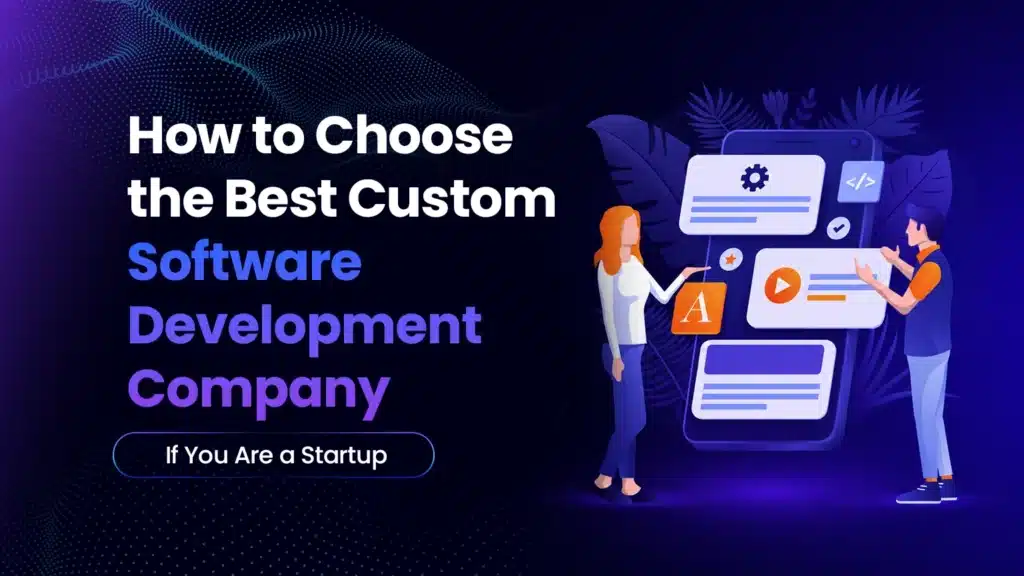
As a startup, finding the right custom software development company for startups is one of the most important decisions you’ll make. The wrong choice can drain your budget, delay your launch, and kill your momentum. The right one becomes a true growth partner. This guide walks you through exactly what to look for, step by step, so you make a confident, informed decision.
Why Startups Need a Custom Software Development Company
Off-the-shelf tools are great for personal use, but startups need software that fits their exact business model. A custom software development company builds solutions tailored specifically to your workflows, users, and goals, not someone else’s.
According to Sources, the global custom software development market is projected to exceed $146 billion by 2030, driven largely by startups demanding flexible, scalable tech stacks. Generic software simply cannot keep pace with the speed at which startups pivot and grow.
When you invest in custom development, you get:
- Software built around your specific processes
- Full ownership of the codebase
- Easier scalability as your business grows
- A competitive edge that off-the-shelf tools can’t offer
- Better integration with your existing tools and platforms
What Makes a Startup’s Software Needs Unique?
Before you start evaluating companies, it’s important to understand what makes your needs different from those of a large enterprise. Startups operate under tight budgets, fast timelines, and constant change. You need a partner who gets that.
Here’s how startup software needs differ:
| Factor | Startup Needs | Enterprise Needs |
| Budget | Lean, milestone-based | Fixed annual budgets |
| Timeline | Fast MVP delivery | Long-term roadmaps |
| Flexibility | High – pivots happen | Lower – processes are set |
| Scalability | Built-in from day one | Often retrofitted later |
| Support | Ongoing, responsive | Structured SLA-based |
Understanding this difference will help you filter out companies that are not truly built for startup collaboration.
Also Read This: How to Build a HIPAA-Compliant Healthcare Web App in the US
10 Key Factors to Choose the Best Custom Software Development Company for Startups
1. Look for Startup-Specific Experience
Not every software company understands the startup mindset. When evaluating a best custom software development company, ask specifically about their experience working with early-stage companies. Have they helped startups build MVPs? Do they understand lean development methodologies?
Look for case studies that show real startup results, not just big enterprise logos. Companies like Lunar Web Solution have a track record of delivering solutions for businesses at every stage of growth, including startups across 30+ industries.
2. Evaluate Their Technical Expertise
Your startup may need a mobile app, a web platform, an AI feature, or all three. Make sure the company you choose has depth across relevant technologies. A top custom software development company should be comfortable working across:
- Frontend: React, Angular, Vue.js, Next.js
- Backend: Node.js, Python, Java, PHP, .NET
- Mobile: Flutter, React Native, iOS, Android
- Cloud & DevOps: AWS, Azure, Docker, Kubernetes
- AI/ML: OpenAI, TensorFlow, LlamaIndex
Don’t just take their word for it, ask for technical documentation, code samples, or a brief technical discussion with their lead engineers.
3. Assess Their Portfolio and Past Work
A strong portfolio speaks louder than any sales pitch. Look at the types of products they’ve built. Do any of them match your industry or the kind of solution you’re building?
A genuinely top custom software development company will openly share:
- Live product links or demo environments
- Industry verticals they have served
- Measurable outcomes (performance gains, user growth, cost savings)
- Technologies used in past projects
If a company is reluctant to show you real work, that is a red flag.
4. Check How They Handle Outsourcing and Team Structure
Many startups consider outsourcing software development to cut costs. This is a smart move if done right. Ask the company how their teams are structured, do they use dedicated teams, staff augmentation, or full project outsourcing?
Each model has pros and cons:
- Full outsourcing – They handle everything. Best for startups without in-house tech.
- Dedicated team – A fixed team works exclusively on your project.
- Staff augmentation – You hire individual developers to fill skill gaps.
For most early-stage startups, a dedicated software development team that works closely with your founder or product lead tends to give the best results.
Lunar Web Solution offers all three models, letting you choose the one that fits your budget and control preferences. Learn more about their software development services.
5. Understand Their Development Process
A professional company will always have a clear, documented development process. Vague answers here are a warning sign. Look for companies that follow proven methodologies like:
- Agile – Iterative sprints with regular client check-ins
- Scrum – Sprint-based planning with a Scrum Master managing priorities
- DevOps – Continuous integration and deployment for faster releases
Ask them: “How do you handle scope changes mid-project?” A company that works well with startups should be comfortable adapting without chaos.
6. Ask About CRM and Enterprise-Grade Solutions
Even if you’re a startup today, your software may need enterprise-level features tomorrow. If your product involves client management, sales pipelines, or operations tracking, ask whether the company can build or integrate a custom CRM software solution.
Choosing a company that understands both startup agility and enterprise custom software development is a huge long-term advantage. You won’t need to switch vendors as you scale.
Lunar Web Solution offers dedicated CRM software development to help businesses manage customer relationships effectively from day one.
7. Evaluate Communication and Transparency
Poor communication is the #1 reason software projects fail. Before signing any contract, pay attention to how the company communicates during the sales process. Are they:
- Responsive to your emails and calls?
- Clear about timelines and deliverables?
- Honest about what they can and cannot do?
- Providing a dedicated point of contact?
Ask whether they use project management tools like Jira, Trello, or Asana to keep clients in the loop. Transparency is not optional, it’s essential.
8. Review Their Pricing Model
For startups, budget management is critical. The best custom software development company for a startup will offer flexible pricing rather than one-size-fits-all rates. Common models include:
| Pricing Model | Best For |
| Fixed Price | Projects with well-defined scope |
| Time & Material | Evolving or agile projects |
| Dedicated Team | Long-term ongoing development |
| Milestone-Based | Startups with limited initial budgets |
Always ask for a detailed breakdown, not just a total number. Hidden costs are common in this industry.
Also Read This: Why Every Business Needs a Custom Software Development Partner
9. Check Post-Launch Support and Maintenance
Building the software is just step one. What happens after launch? Bugs appear. Users request features. Servers go down. You need a partner who stays with you.
Good software maintenance and support includes:
- Bug fixes and security patches
- Performance monitoring
- Feature updates based on user feedback
- Server and infrastructure management
Ask the company specifically: “What does your post-launch support look like, and what are the costs?” Make sure it’s included or priced separately in writing.
Lunar Web Solution provides dedicated IT support and maintenance services so your product keeps running smoothly long after launch.
10. Verify Security Practices
Your startup may handle sensitive user data, payment information, or health records. Security cannot be an afterthought. Ask the company:
- Do you follow OWASP security standards?
- Do you conduct penetration testing and code audits?
- How do you handle data encryption and access control?
A reputable company will be happy to walk you through their security practices. If they brush this off, walk away.
Questions to Ask Before You Hire Custom Software Developers
When you sit down (virtually or in person) to evaluate a company, come prepared. Here are the key questions to ask before you hire custom software developers:
- Can you share 3 case studies of startup projects you’ve delivered?
- Who will be my dedicated point of contact throughout the project?
- How do you handle project scope changes?
- What is your typical timeline for an MVP?
- What technologies do you recommend for my specific use case?
- How do you handle intellectual property and code ownership?
- What does your post-launch support plan look like?
- Have you worked in my industry before?
- What testing and QA processes do you follow?
- Can we start with a smaller paid pilot project before committing fully?
That last question is particularly important. Starting with a small, well-scoped task, like a landing page or a single module, lets you evaluate the company’s work before making a larger commitment.
Red Flags to Watch Out For
Not every company that calls itself the “best” deserves that title. Watch out for these warning signs when shortlisting vendors:
- No portfolio or case studies – They can’t show what they’ve built
- Vague timelines – “It depends” with no further detail
- No post-launch support – They disappear after delivery
- Lowest price guarantee – Quality costs something; be skeptical of extremely low bids
- No development process – They “just start coding”
- Offshore-only teams with no project manager – Communication will be a nightmare
- No NDA or IP ownership clause – This is a legal and security risk
Custom Software vs. Off-the-Shelf: A Quick Comparison
Still wondering if custom development is the right call for your startup? Here’s a side-by-side comparison to help you decide:
| Feature | Custom Software | Off-the-Shelf Software |
| Fits your exact needs | ✅ Yes | ❌ Rarely |
| Scalable with your growth | ✅ Yes | ⚠️ Limited |
| Upfront cost | Higher | Lower |
| Long-term cost | Lower | Higher (subscriptions + add-ons) |
| You own the code | ✅ Yes | ❌ No |
| Competitive advantage | ✅ High | ❌ None (everyone uses the same tool) |
| Integration flexibility | ✅ Full | ⚠️ Limited |
For most startups building a product (not just using tools internally), custom software development is the smarter long-term investment.
Also Read This: Benefits of Custom Software Development Solutions for Small Businesses
Industries Where Startups Commonly Need Custom Software
No matter what industry your startup operates in, custom software can give you an edge. Here are some verticals where this is especially true:
- Healthcare – HIPAA-compliant patient management, telehealth platforms → Healthcare Software Development
- Fintech – Payment processing, lending platforms, financial dashboards → Financial Software Development
- eCommerce – Custom storefronts, inventory management, order tracking → eCommerce App Development
- SaaS – Subscription management, multi-tenant architecture → SaaS App Development
- Logistics – Route optimization, fleet tracking, warehouse management → Logistics Software Development
- Education – LMS platforms, student portals, e-learning tools → Education App Development
If your startup operates in any of these spaces, working with a company that has domain expertise in your industry is a major advantage.
How to Shortlist and Compare Software Development Companies
Once you’ve done your research, here’s a practical shortlisting process:
Step 1 – Create a list of 5–8 companies based on Google searches, Clutch.co reviews, LinkedIn, and referrals.
Step 2 – Review their portfolios and check if they’ve worked in your industry or built something similar to what you need.
Step 3 – Send a brief RFP (Request for Proposal) – a short document describing your project, goals, timeline, and budget range.
Step 4 – Schedule discovery calls with your top 3 candidates. Pay attention to how they listen, ask questions, and suggest solutions.
Step 5 – Compare proposals side by side – not just on price, but on approach, team structure, timeline, and post-launch support.
Step 6 – Ask for references and actually call them. Ask: “Would you work with this company again, and why?”
Step 7 – Start small – a paid discovery phase or pilot project before a full commitment.
According to Clutch.co, companies that go through a structured evaluation process are 3x more likely to be satisfied with their final vendor choice.
Why Lunar Web Solution Is a Strong Choice for Startups
If you’re actively looking for a reliable custom software development company for startups, Lunar Web Solution checks all the right boxes:
- 10+ years of experience in software development across 30+ industries
- 350+ solutions delivered globally, including healthcare, fintech, eCommerce, SaaS, and more
- Full-stack capabilities – web, mobile, AI/ML, cloud, DevOps, CRM, ERP, and more
- Flexible engagement models – dedicated teams, full outsourcing, and staff augmentation
- Transparent, agile process with regular client check-ins and sprint reviews
- Post-launch support, including IT support and maintenance, and testing & QA
- Offices in the USA, UK, and India for global reach and time-zone friendly communication
Their team has worked with startups from the seed stage all the way to Series B, building everything from MVPs to full enterprise platforms.
You can explore their complete range of software development services or reach out directly for a free consultation.
Final Checklist Before You Sign the Contract
Before you commit to any company, run through this quick checklist:
- Portfolio reviewed and verified
- Technical expertise confirmed for your stack
- Clear development process and methodology explained
- Pricing model fits your budget and project type
- Post-launch support plan agreed upon in writing
- IP ownership and NDA clauses included in contract
- References contacted and verified
- Communication tools and frequency agreed upon
- Security practices confirmed
- A pilot or discovery phase agreed upon before full engagement
If you can check every box, you’re in a strong position to move forward confidently.
Conclusion
Choosing the right custom software development company for startups is not just a technical decision, it’s a business-critical one. The company you choose will shape your product, your timeline, your budget, and ultimately your chances of success.
Take the time to evaluate properly. Look beyond the price tag. Ask hard questions. Start small if you’re unsure. And prioritize companies that genuinely understand the startup world, not just those with the biggest marketing budgets.
If you’d like to explore what’s possible for your startup, Lunar Web Solution offers a free initial consultation to help you define your project, estimate costs, and plan your development roadmap.
Your idea deserves software that’s built right, from the ground up.
Frequently Asked Questions (FAQs)
Q1. What should a startup look for in a custom software development company?
A startup should look for a company with proven experience in building startup-focused products, a flexible engagement model, a clear development process, and strong post-launch support. Technical expertise in your required stack, transparent pricing, and good communication practices are equally important. Always check their portfolio and ask for references before committing.
Q2. How much does it cost to hire a custom software development company for a startup?
The cost varies significantly based on the scope, complexity, and team structure. A simple MVP can range from $15,000 to $50,000, while a full-featured product can cost $100,000 or more. Companies like Lunar Web Solution offer milestone-based and dedicated team pricing models that help startups manage costs more predictably. Always request a detailed breakdown rather than a lump-sum quote.
Q3. Is outsourcing software development a good idea for startups?
Yes, outsourcing software development is often the smartest choice for startups that don’t have an in-house technical team. It gives you access to experienced developers at a lower cost than hiring full-time employees, reduces time to market, and lets you focus on business development. The key is choosing a reliable partner with a structured process and strong communication.
Q4. What is the difference between a dedicated team and staff augmentation?
A dedicated software development team means the agency assigns a full team, developers, designers, QA engineers, and a project manager- to work exclusively on your project. Staff augmentation means you add individual developers to your existing in-house team to fill specific skill gaps. Dedicated teams are ideal for startups building a product from scratch, while staff augmentation works better when you already have some developers in-house.
Q5. How long does it take to build a custom software product for a startup?
The timeline depends on the product’s complexity. A basic MVP with core features can be built in 8 to 16 weeks. A more complex product with multiple integrations, advanced features, or AI capabilities may take 6 to 12 months. A professional custom software development company for startups will give you a clear timeline during the discovery phase, broken down by milestones.
Q6. What is the importance of post-launch software maintenance and support?
After launch, your product will need regular bug fixes, security updates, performance improvements, and new features based on user feedback. Without proper software maintenance and support, even a well-built product can degrade over time or become a security risk. Good maintenance keeps your product competitive, reliable, and scalable as your startup grows.
Q7. Can a custom software development company also help with CRM and enterprise-level solutions?
Yes. If your startup needs tools for managing customer relationships, sales pipelines, or internal operations, a capable custom CRM software development company can build these into your product from the start, or integrate them with your existing systems. Choosing an agency that handles both startup-scale and enterprise-grade solutions means you won’t need to switch vendors as you grow. Lunar Web Solution offers CRM software development and Enterprise Resource Planning (ERP) solutions designed to scale with your business.


 02/21/2025