If you have been following tech news lately, you have probably heard both “chatbot” and “AI agent” thrown around constantly, often as if they mean the same thing. They do not. And for a business owner or decision-maker trying to figure out which AI solution to invest in, that confusion is costly. The chatbot vs AI agent debate matters more than ever in 2026. According to Gartner, 40% of enterprise applications will embed task-specific AI agents by the end of 2026, up from less than 5% in 2025. Meanwhile, 80% of companies are still expected to rely on AI chatbots for customer service. Both technologies are growing — but they serve very different purposes.
In this guide, we cut through the jargon and explain what chatbot vs AI agent actually are, how they work, where each one shines, and most importantly which one your business needs right now.
What Is a Chatbot?
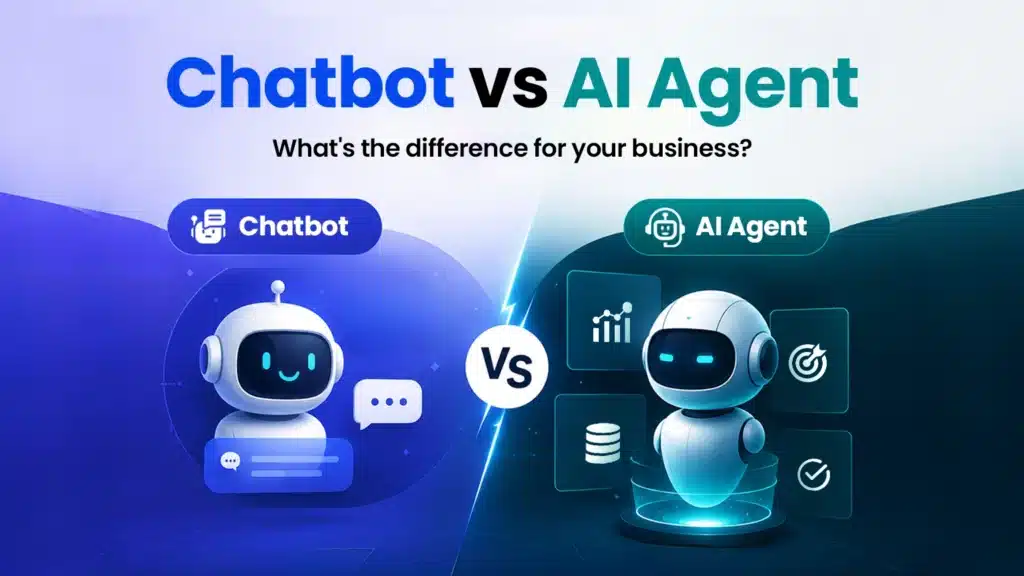
A chatbot is a software program designed to simulate a conversation with a human user. It waits for a user to ask a question, then responds based on either a predefined script or a language model.
Modern chatbots fall into two main types:
Rule-based chatbots follow a fixed decision tree. They work like a flowchart: if the user says X, respond with Y. They cannot handle anything outside their script, but they are cheap to build and reliable for predictable, simple queries. Think of the “press 1 for billing” menus that evolved into a text interface.
AI-powered chatbots (also called LLM chatbots) use a large language model to understand natural language. They can handle varied phrasing, answer follow-up questions, and pull information from a knowledge base using a technique called RAG (Retrieval-Augmented Generation). These are the customer-facing bots you see on SaaS websites, eCommerce stores, and banking apps today.
What both types have in common is this: a chatbot responds. It does not act.
Once it gives you an answer, its job is done. It does not go into your CRM to update a record. It does not trigger a refund in your payment system. It does not schedule a follow-up email. It answers and waits for the next question.
Common Chatbot Use Cases
- Answering FAQs on a website 24/7
- Guiding customers through return or cancellation policies
- Collecting lead information (name, email, company size)
- Booking appointments or support tickets
- Providing product recommendations based on basic filters
- Handling tier-1 customer support queries
What Is an AI Agent?
An AI agent is a fundamentally different kind of system. Where a chatbot responds to a prompt, an AI agent takes action toward a goal — often without being told exactly how to do it at every step.
Think of an AI agent as a digital employee that can reason, plan, use tools, and execute multi-step workflows autonomously. It does not just answer “What is your refund policy?” — it processes the refund request, updates your inventory, logs the interaction in your CRM, and sends the customer a confirmation email. All without a human touching it.
Here is the technical structure behind an AI agent:
- Reasoning engine — usually a large language model that understands goals and context
- Memory — the ability to retain context across multiple steps or sessions
- Tool access — APIs, databases, code execution, web browsing, file systems
- Action loop — the agent observes, reasons, acts, and checks whether the goal has been achieved before moving on
This observe-reason-act loop is what separates an agent from a chatbot. A chatbot processes one message at a time. An agent chains multiple actions together to solve a compound problem — and keeps going until the task is done.
Common AI Agent Use Cases
- Autonomously qualifying and routing inbound sales leads
- Processing customer refunds end-to-end across multiple systems
- Monitoring inventory and automatically placing purchase orders
- Drafting and sending personalized follow-up emails after sales calls
- Extracting, summarizing, and filing data from incoming documents
- Handling multi-step onboarding workflows for new customers
- Running competitive research and surfacing weekly summaries to your team
Chatbot vs AI Agent: The Core Difference Explained Simply
If you remember nothing else from this article, remember this:
A chatbot talks. An AI agent acts.
Here is a concrete example that illustrates the difference:
Scenario: A customer visits your website and wants to return a product.
What a chatbot does: It reads the customer’s message, recognizes the intent, and replies: “Our return policy is 30 days. Please fill out the return form at this link.” Done.
What an AI agent does: It reads the customer’s message, verifies the order details in your database, confirms the item is within the return window, initiates the return workflow, updates your inventory system, schedules the refund in your payment processor, and sends the customer a confirmation email with a return label — all automatically, with no human involved.
Same starting point. Wildly different chatbot vs AI agent outcomes.
Chatbot vs AI Agent: Full Comparison Table
| Factor | Chatbot | AI Agent |
|---|---|---|
| Primary function | Respond to user queries | Execute tasks and achieve goals |
| Behavior | Reactive (waits for input) | Proactive (acts on triggers or goals) |
| Decision-making | Follows script or single LLM call | Multi-step reasoning and planning |
| Memory | Limited to current session | Persistent memory across sessions |
| Tool integration | Minimal (may read a knowledge base) | Deep (APIs, databases, code, browsers) |
| Autonomy | Low | High |
| Complexity of tasks | Simple, predictable | Complex, multi-step |
| Human oversight needed | Low (can run fully automated) | Moderate (best with human-in-the-loop) |
| Setup cost | Lower | Higher |
| Ongoing cost per task | Very low | Moderate (more API calls, compute) |
| Best for | FAQs, support, lead capture | Workflow automation, operations, sales |
| Examples | Intercom, Drift, Tidio, Freshdesk | AutoGPT, Salesforce Agentforce, custom agents |
Why the Difference Matters for Your Business in 2026
The confusion between chatbot vs AI agent is not just semantic — it leads to real business mistakes. Companies either:
- Over-invest by deploying an expensive AI agent for a use case a basic chatbot handles perfectly well, or
- Under-invest by expecting a chatbot to automate complex workflows it was never designed to handle — then blaming “AI” when results disappoint.
Here is a framework to help you avoid both:
When a chatbot is the right choice
A chatbot is the right tool when your use case involves answering predictable, repetitive questions where no action needs to happen across external systems. If your support team answers the same 50–200 questions every week about pricing, policies, and product features — a well-configured AI chatbot can handle that volume at a fraction of the cost of human agents.
Chatbots are also the right choice when:
- Your budget for AI is limited and you need a fast ROI
- Your workflows are linear and do not require decisions across multiple systems
- You want to capture leads and qualify interest before a human takes over
- You are testing AI adoption for the first time and want a low-risk starting point
When an AI agent is the right choice
An AI agent is worth the investment when tasks span multiple systems, require decisions based on live data, need follow-up actions, or currently require a human to do copy-paste work between platforms.
Signs your business needs an AI agent:
- Your team manually transfers data between tools (e.g., CRM, email, invoicing)
- Customer requests require checking multiple databases before responding
- You want to automate sales follow-ups at scale with personalization
- Your onboarding, operations, or fulfillment workflows have 5+ steps involving different tools
- You want AI that proactively surfaces insights or takes action — not just answers questions
The State of AI Agents in Business: 2026 Statistics
The numbers tell a clear story about where the market is heading.
- The global AI agents market is projected to exceed $10.9 billion in 2026, up from $7.6 billion in 2025 — growing at over 45% CAGR.
- 38% of mid-size and large companies now use at least one AI agent in daily operations.
- Enterprise AI agent adoption grew 46% year-over-year between 2025 and 2026.
- Gartner forecasts that 40% of enterprise applications will embed task-specific AI agents by end of 2026.
- Businesses deploying AI agents report 3–15% revenue uplift and 10–20% increase in sales ROI.
- 55% higher operational efficiency and 35% cost reductions are reported by businesses using AI agents broadly.
- McKinsey estimates that AI agents could add $2.6 to $4.4 trillion in annual value across business use cases globally.
These numbers do not mean every business needs an AI agent today. They mean that businesses which identify the right use cases and deploy intelligently are already pulling ahead of competitors who are not.
Real-World Industry Examples of Chatbot vs AI Agent
eCommerce
A chatbot on your product page answers “Does this come in size L?” An AI agent monitors cart abandonment, sends a personalized recovery email with the exact product the customer left behind, applies a time-sensitive discount, and logs the outcome in your analytics platform — all triggered automatically when a user exits without purchasing.
Healthcare (US)
A chatbot answers “What are your clinic hours?” or “Do you accept Blue Cross insurance?” An AI agent reviews an incoming patient intake form, flags missing information, cross-references the patient’s insurance eligibility in real time, and schedules them into the first available appropriate appointment slot — without a front desk staff member doing any of it.
Finance and Accounting
A chatbot answers “When is my invoice due?” An AI agent receives an invoice via email, extracts the line items, matches them against purchase orders in your accounting software, flags discrepancies, and routes the invoice for approval — eliminating hours of manual data entry every week.
Sales and Marketing
A chatbot captures a lead’s name and email on a landing page. An AI agent identifies a high-value prospect visiting your pricing page, enriches their profile with company data, sends a personalized outreach sequence, logs the activity in Salesforce, and alerts the sales rep when the prospect opens the third email — without the rep lifting a finger.
Can You Have Both? Yes and You Probably Should.
Many businesses find the most value in a layered approach: a chatbot handles the high volume of simple, repetitive queries (freeing up your human team from tier-1 support), while AI agents handle the complex, multi-step workflows that used to eat hours of employee time.
Think of it as a relay race. The chatbot is the first runner — fast, efficient, handles the easy terrain. The AI agent is the specialist who takes the baton when the course gets complicated.
For example, a US-based software company might deploy:
- A chatbot to handle all inbound support questions and capture leads 24/7
- An AI agent to qualify leads overnight, enrich them with company data, prioritize by deal size, and draft personalized intro emails for the sales team each morning
The combined system costs a fraction of hiring additional staff — and it never sleeps.
What Should Your Business Do Next?
Before investing in either technology, ask yourself these five questions:
- What specific problem am I trying to solve? Define the outcome, not the technology.
- Is the task repetitive and predictable, or complex and multi-step? Repetitive → chatbot. Complex → agent.
- Does completing the task require accessing or updating multiple systems? If yes, you likely need an AI agent.
- What is my risk tolerance? Chatbots are lower risk to deploy. AI agents require more oversight, especially early on.
- What is my budget? Chatbots are cheaper to build and run. AI agents have higher upfront and per-task costs but deliver greater ROI on complex workflows.
If you are not sure where to start, the answer is almost always: start with a chatbot for one high-volume use case, measure the results, and then identify the workflows where an AI agent would unlock the next level of value.
Build the Right AI Solution with Lunar Web Solution
At Lunar Web Solution, we help US businesses design and build the right AI solution for their specific goals — whether that is a smart chatbot that handles thousands of customer queries per day, or a fully custom AI agent that automates your most time-consuming workflows.
We do not sell you a product. We build a solution that fits your business — your systems, your team, and your growth plans.
Talk to Our AI Development Team Today
Frequently Asked Questions
Q: What is the main difference between a chatbot and an AI agent?
A: A chatbot responds to questions. An AI agent takes action toward goals — it can reason, plan, use tools, and execute multi-step workflows autonomously across multiple systems.
Q: Is an AI agent more expensive than a chatbot?
A: Yes, generally. AI agents consume more computational resources, make multiple API calls per task, and require more sophisticated infrastructure. However, for complex workflows that replace human labor, agents can deliver significant ROI despite higher operating costs.
Q: Can a small business use AI agents?
A: Yes. AI agents do not require enterprise budgets in 2026. Many platforms offer agent capabilities at accessible price points. The key is identifying one specific workflow where the ROI is clear — such as lead qualification or invoice processing — and starting there.
Q: What industries benefit most from AI agents?
A: Customer service, eCommerce, finance, healthcare, sales, and supply chain are the leading industries seeing measurable ROI from AI agent deployments in 2026.
Q: Is ChatGPT a chatbot or an AI agent?
A: In its standard conversational mode, ChatGPT is a chatbot — it responds to prompts. When integrated with tools (like browsing, code execution, or API access) and placed inside a reasoning loop, it can function as an AI agent. The architecture around the model determines which category it falls into.
Q: How do I know if my business needs an AI agent?
A: If your team regularly does multi-step, repetitive work across more than one software tool — moving data between systems, manually following up, or managing complex workflows — an AI agent is worth evaluating. If your primary need is answering questions quickly at scale, a chatbot is likely sufficient.


 02/21/2025